Bass day (1h 45m)

Finally a bass session! 😃

Warm-up

  • Be My Love in C
    • Basic Latin (1-5, 3rds, some chromatic passages)

Scale studies

  • Harmonic minor in all keys
  • Harmonic minor dissection (bass variation): figure #1 — sheet music coming soon
  • Harmonic minor dissection (bass variation): figure #2

Reading

  • Hrabe etude #7

Pick + technique

  • Famous blues lines by Larry McCabe — figure #5 (C, D)

Observations

If there’s one thing in this multiverse that can make me instantly get back on my track and feel great again — it’s sight reading on bass. I was missing it so badly!


Piano day (1h 40m)

Scale studies

  • All Lydian scales
  • All Ionian scales
  • Scale dissection: C#, F#, A Phrygian over moving minor arpeggios

Left hand + comping

Interpretation

  • The Beatles — All My Loving (variation #2)
    • LH: broken 10ths (alternating ascending & descending)
    • Chromatic side-slipping (found in Dan Harle’s Jazz Improvisation for Keyboard Players)
    • Gershwin reversed stride bass
    • RH: arpeggiated shells, voice leading

Next time focus

  • Locrian + Mixolydian week
  • Try chromatic side-slipping in right hand as well
  • Back to embellished ii — V — i’s
  • Next left hand pattern
  • Scale dissection over permutations — attempt #2 😄

Practice session: permutations and more Gershwin studies

Scale studies

  • All Lydian scales
  • All Ionian scales
  • Scale dissection: Ab Lydian over Ab∆7 moving arpeggios in groups of two
  • Scale dissection: F# Dorian over F#m7 moving arpeggios in groups of three
  • Scale dissection #2: F# Dorian in groups of three over F#m7 regrouped arpeggios
  • Scale dissection #3: F# Dorian in groups of three over all F#m7 inversions in 1-3-5-7 permutations (several slow passes, but couldn’t really play it fluently)

Left hand

  • Gershwin reversed stride bass (#14 from Jazz Piano: The Left Hand)
    • Original chord progression (dominant descent over the cycle of 4ths from F#, in fact 🤓)
    • Minor variation
      • Only reversed stride in 3-7 → R | 7-10 → R pattern
      • Reversed stride + broken 10ths + block triads up the octave (sounds super dope 🔥)
  • Descending 10ths in a free jam: focus on 10-5 movement

Improvisation

  • Major blues scale around the cycle (quick recap)

Session timing: 2h 30m

Observations

Variations are great! It definitely is much more inspiring an empowering than simply learning the piece from sheet music and finally reading it without any errors. Understanding the logic behind the particular composition and the techniques that are used in it — and then being able to freely play your variation of it in which one can still recognise the original — this is extremely satisfying.

Scale practice routine that’s as fun as drugs are bad

I promised to come back with more non-boring scale practice routine ideas, so here they are. I think I made it clear enough in this blog that I hate doing mechanical exercises and thoughtlessly practicing patterns. That’s not very helpful in a real-life situation (still, knowing fingering is important!) Anyway, here’s what I do when I want to learn the scale and be able to use it and also enjoy the sound of my exercise.

I call it scale dissection. You literally take the scale and divide it into small diatonic lines and then snort them in one after another (I swear I tried to come up with the better analogy). It could be something as easy as 1-2, 3-4, 5-6, 7-1, or more sophisticated as b7-1, 1-b3, 5-1, 1-5-10 — you name it. Bottom line, it has to consist of scale tones. To keep left hand busy, you can choose something not very brain-processing-heavy, like a common pattern (see previous post) or — in this case — arpeggiated inversions. This would also improve hand independence. Playing dissected scale and arpeggiated inversion in the adjacent octaves is recommended for the maximum level of brain fuck.

Just like doing an ollie 360 on a skateboard, trying the whole thing unprepared might result in injuries, therefore it might be helpful to approach in three stages:

Screenshot 2019-03-29 at 22.25.17.png

I’m making a one measure pause after each bit to buy me some time and figure out the notes and fingering. Next, making sure I can play arpeggios steadily enough to not to care too much about the right hand:

Screenshot 2019-03-29 at 21.53.23.png

And, finally, the full version:

Screenshot 2019-03-29 at 22.25.35.png

And that’s just one scale! You can do the same in C minor now:
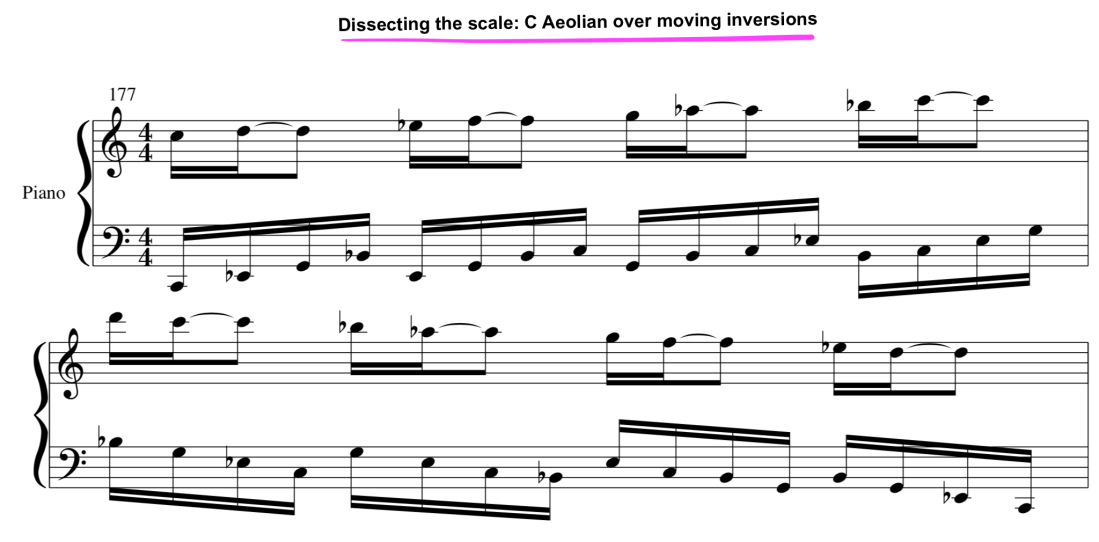
Screenshot 2019-03-29 at 22.27.39.png

And the beauty of this routine is that you don’t have to play the same stuff in all keys. If you feel like it, you can dissect C minor in a completely different way — and then practice switching to in from F minor pattern seamlessly! Sounds like another 2 hours of work right?

Also, all arpeggiated inversions could be replaced with chord permutations (like, 1-3-5-7 or 3-7-5-1, etc.), which can then also be inverted. And what about blues and bebop scales? What about bloody Vagadhisvari scale? You get the idea. Have fun—

Gershwin’s reversed stride bass and best practice moments

Scale studies

  • All Lydian scales
  • All Ionian scales in contrary motion
  • Lydian scales dissection over moving arpeggiated inversions (C, F, Bb)

Left hand

  • Gershwin’s reversed stride bass — study + applying (from Jazz Piano: The Left Hand by Riccardo Scivales
IMG_0536 2
Yes, the notes I make in my textbooks look exactly as they look here 😆

Observations

I was studying a fragment from the Gershwin piece today where he uses a particular bass pattern, and it felt so satisfying to finally get it: ah, that’s what he’s doing here! After half an hour of meandering it just clicked. Probably the best moment in piano practice: when you’re slowly digging your way through the piece, dreaded by all the sheet music, and it feels so weird and complicated, and then — bam! — the logic kicks in and you realise what exactly is happening here. And then you can just play it without even looking at the sheet music.

Session timing: 1h 45m