Harmonic minor dissection (bass variation): figure #1 — sheet music coming soon
Harmonic minor dissection (bass variation): figure #2
Reading
Hrabe etude #7
Pick + technique
Famous blues lines by Larry McCabe — figure #5 (C, D)
Observations
If there’s one thing in this multiverse that can make me instantly get back on my track and feel great again — it’s sight reading on bass. I was missing it so badly!
Scale dissection: Ab Lydian over Ab∆7 moving arpeggios in groups of two
Scale dissection: F# Dorian over F#m7 moving arpeggios in groups of three
Scale dissection #2: F# Dorian in groups of three over F#m7 regrouped arpeggios
Scale dissection #3: F# Dorian in groups of three over all F#m7 inversions in 1-3-5-7 permutations (several slow passes, but couldn’t really play it fluently)
Original chord progression (dominant descent over the cycle of 4ths from F#, in fact 🤓)
Minor variation
Only reversed stride in 3-7 → R | 7-10 → R pattern
Reversed stride + broken 10ths + block triads up the octave (sounds super dope🔥)
Descending 10ths in a free jam: focus on 10-5 movement
Improvisation
Major blues scale around the cycle (quick recap)
Session timing: 2h 30m
Observations
Variations are great! It definitely is much more inspiring an empowering than simply learning the piece from sheet music and finally reading it without any errors. Understanding the logic behind the particular composition and the techniques that are used in it — and then being able to freely play your variation of it in which one can still recognise the original — this is extremely satisfying.
Lydian scales dissection over moving arpeggiated inversions (C, F, Bb)
Left hand
Gershwin’s reversed stride bass — study + applying (from Jazz Piano: The Left Hand by Riccardo Scivales
Yes, the notes I make in my textbooks look exactly as they look here 😆
Observations
I was studying a fragment from the Gershwin piece today where he uses a particular bass pattern, and it felt so satisfying to finally get it: ah, that’s what he’s doing here! After half an hour of meandering it just clicked. Probably the best moment in piano practice: when you’re slowly digging your way through the piece, dreaded by all the sheet music, and it feels so weird and complicated, and then — bam! — the logic kicks in and you realise what exactly is happening here. And then you can just play it without even looking at the sheet music.
I love combining different workouts in one so that I don’t spend two hours just doing arpeggios and then another two hours trying to make them work with right hand patterns. My approach is to work on both hands at the same time by putting emphasis on one of them and keeping the second busy with something super simple and minimally technical, yet still meaningful in terms of theory. But, there’s also a possibility to pack one more thing in an exercise — and that’s when you make it modal!
For this one a picked the classic Mixolydian progression: I7 — bVII∆7 and played it it using 7th chord arpeggios with left hand and doubled intervals in the right.
Stuff I improve while practicing this:
Modal DNA
Arpeggios
Diatonic intervals
Sure enough, you can transpose it to any key or apply to any modal progression like Dorian i — IV7 or Phrygian i — bII∆7, etc.
I was always wondering: how do they do it? The pro piano players who take pop songs and create wonderful, authentic instrumental versions of them that sound awesome on their own without vocals. I remember jealously listening to those pieces and thinking — damn, I’ll never be able to do this — and then going back to my block triads with octave bass. It’s okay, son, don’t go too hard on yourself—
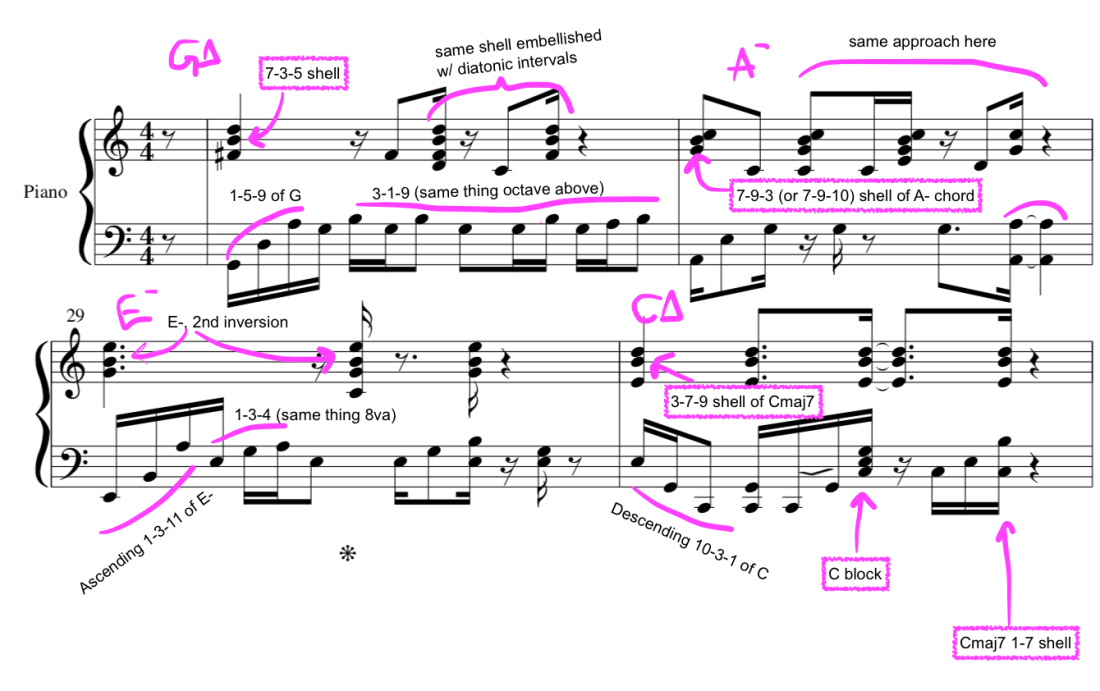
Well guess what! I won’t say I’ve mastered it, but I hacked it, and now it’s just a question of practice hours, baby. I call this exercise “Pop Jam” — the idea is dead simple:
Find chords on the Interwebs (or in the Real Book if you’re into jazz standards)
Play through the whole chart once with block chords and simplest bass on Earth
Then replace block chords with shell voicings and connect them using minimal movement principle and thus achieving sweet ass voice leading
Add broken 10ths in left hand
Break shells in right hand into arpeggios (or some semblance of)
Add other intervals and ascending / descending movements in left hand (1-5-10, 10-9-3-1, whatever)
Use diatonic passages in right hand instead of shells
Throw in super low bass in left hand in key moments
Combine everything
Perform it until it’s suddenly 4 AM
Here are some parts of this approach illustrated with an example of Katy Perry’s vintage banger Fireworks (first four bars):
Here’s what it sounds like:
It’s barely recognisable, I know. Of course it is, because it’s a freaking interpretation! 😄


 Black Hole Piano