Practice session: scale dissection and revisited ii — V — I’s

Scale studies

Jazz voicings + left hand

Observations

Scale dissection is getting much better, but still sucks in Bb- and other keys with a lot of accidentals, where the “white are 1 & 2, black are 3 & 7” pattern is not there anymore. This is why visual pattern are shit! To take a slightly better thought-through analogy, they are like sugar — addictive and unhealthy! 😄

Session timing: 1h 40m

Becoming a scale monster

Last week I’ve shared a non-boring scale hack that is supposed to turn the scale studies that are often viewed as boring and mechanical into an — quoting Dan Haerle — extremely entertaining pastime. I am using it all the time, and just recently I’ve come up with a new workout that could be viewed as a sequel to the original one. Word of warning: its efficiency in terms of fucking up your brain and your finger muscles has improved exponentially. This is why I called it The Scale Monster.

At some point in my bass training I have been introduced to the concept of chord permutations. Basically, it’s just pure math: you have a 7th chord arpeggio, and there are 24 ways to play these notes in a sequence. Not a big deal, right? Later, you realise that you can then take all inversions of this chord and permutate them. Which will give you 96 sequences. Which you will then transpose to all keys and circle around all the modes and create all the Western music.

Of course, it would be crazy for a human to just mechanically practice this hell (although it does improve your fluency tremendously). Instead, you can just use it as a pool of pre-generated patterns to sex up your routine!

Check it out — this is just a regular F#m7 chord played consequently in all inversions:
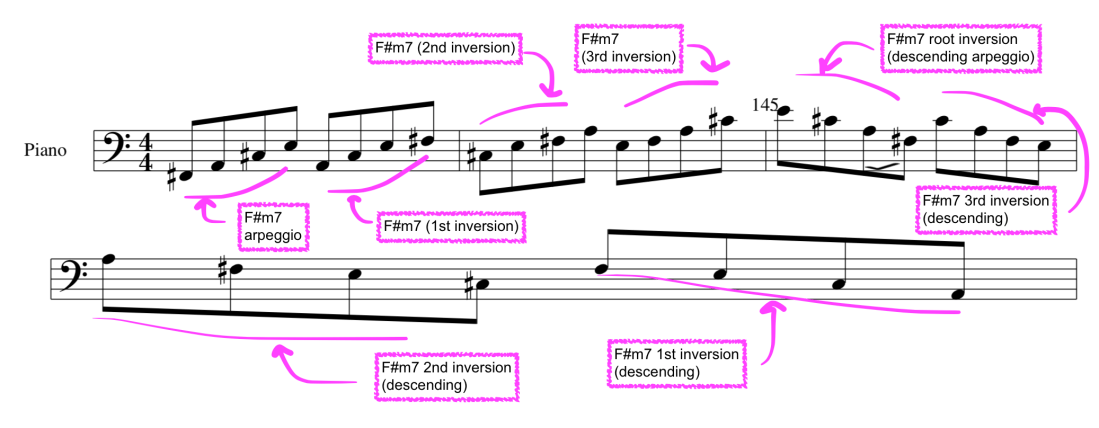
Screenshot 2019-04-03 at 20.08.34.png

Easy, right?

Going on — F#m7 in all permutations starting on 1:

Screenshot 2019-04-03 at 20.15.51.png

Personally, I just like how it sounds. There is no trace of that worn-out minor arpeggio sound that so many other people are practicing at this very moment all around the world. Yes, it’s a bit robotic — but — we’ll fix that in a sec.

Next — my “aha!” moment: 1st inversion in different permutations:
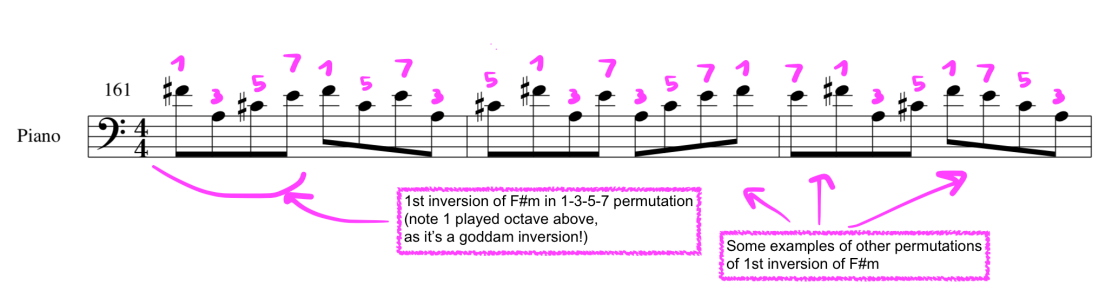
Screenshot 2019-04-03 at 20.21.48.png

Note that permutating the inversion does not give you the same results as permutating the original chord, as the root (aka 1) is transposed one octave above. So it’s a completely different set of combinations.

As a next step, I’m going to take one permutation of choice (1-3-5-7 in this case) and play all inversions of my F#m7 using it — ascending, then descending:

Screenshot 2019-04-03 at 20.32.29.png

And finally, add the right hand that is going to play the F# Dorian scale dissected into groups of 2 notes:
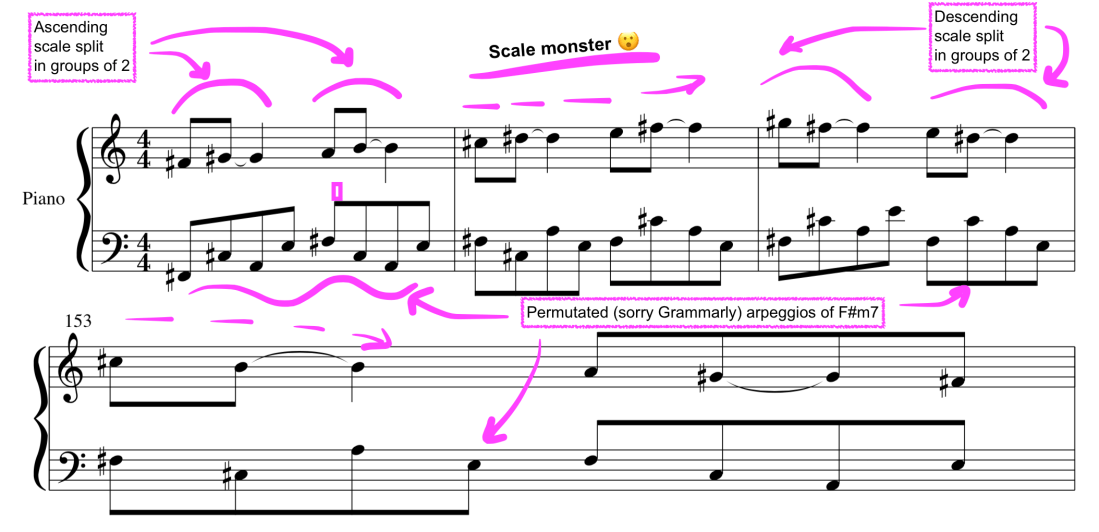
Screenshot 2019-04-03 at 20.42.13.png

If up until this point you were only mildly challenging the part of your brain responsible for scale fluency, now’s the moment when you finger independence gets fucked up big time! 🤓

Not all of it might sound great — as particular permutations might create dissonant intervals with scale degrees, but that only means that you can spend another two hours trying out other ones figuring out the best combination. And — remember — it was only F# Dorian over F#m7. Sooo… You get the idea 🤙🏻 Harmonise ’till it hurts! Till next time—

Piano day (1h 40m)

Scale studies

  • All Lydian scales
  • All Ionian scales
  • Scale dissection: C#, F#, A Phrygian over moving minor arpeggios

Left hand + comping

Interpretation

  • The Beatles — All My Loving (variation #2)
    • LH: broken 10ths (alternating ascending & descending)
    • Chromatic side-slipping (found in Dan Harle’s Jazz Improvisation for Keyboard Players)
    • Gershwin reversed stride bass
    • RH: arpeggiated shells, voice leading

Next time focus

  • Locrian + Mixolydian week
  • Try chromatic side-slipping in right hand as well
  • Back to embellished ii — V — i’s
  • Next left hand pattern
  • Scale dissection over permutations — attempt #2 😄

Practice session: permutations and more Gershwin studies

Scale studies

  • All Lydian scales
  • All Ionian scales
  • Scale dissection: Ab Lydian over Ab∆7 moving arpeggios in groups of two
  • Scale dissection: F# Dorian over F#m7 moving arpeggios in groups of three
  • Scale dissection #2: F# Dorian in groups of three over F#m7 regrouped arpeggios
  • Scale dissection #3: F# Dorian in groups of three over all F#m7 inversions in 1-3-5-7 permutations (several slow passes, but couldn’t really play it fluently)

Left hand

  • Gershwin reversed stride bass (#14 from Jazz Piano: The Left Hand)
    • Original chord progression (dominant descent over the cycle of 4ths from F#, in fact 🤓)
    • Minor variation
      • Only reversed stride in 3-7 → R | 7-10 → R pattern
      • Reversed stride + broken 10ths + block triads up the octave (sounds super dope 🔥)
  • Descending 10ths in a free jam: focus on 10-5 movement

Improvisation

  • Major blues scale around the cycle (quick recap)

Session timing: 2h 30m

Observations

Variations are great! It definitely is much more inspiring an empowering than simply learning the piece from sheet music and finally reading it without any errors. Understanding the logic behind the particular composition and the techniques that are used in it — and then being able to freely play your variation of it in which one can still recognise the original — this is extremely satisfying.