Yes, ascending melodic minor is an extremely dissonant scale. I mean, it’s in the nature of it: it’s literally major and minor sewn together, how can it not be dissonant! But, as always, somewhere in the middle of all this harshness, there’s an undulating beauty, its DNA, so magnificent and fragile that it compensates all the clashing around it. I just have to find it 🤓
Scale dissection: C, F, Bb & Eb Lydian over arpeggiated scale degrees in groups of 3
Here’s what I mean:
Surprisingly, it’s slightly easier to play than over the moving root arpeggio (because you don’t have to think about inversions all the time and simply go up the scale degrees) — and it sounds much better. Especially in sweet Lydian mode 🍭 Might get tricky in keys with a lot of accidentals though.
Jazz voicings + left hand
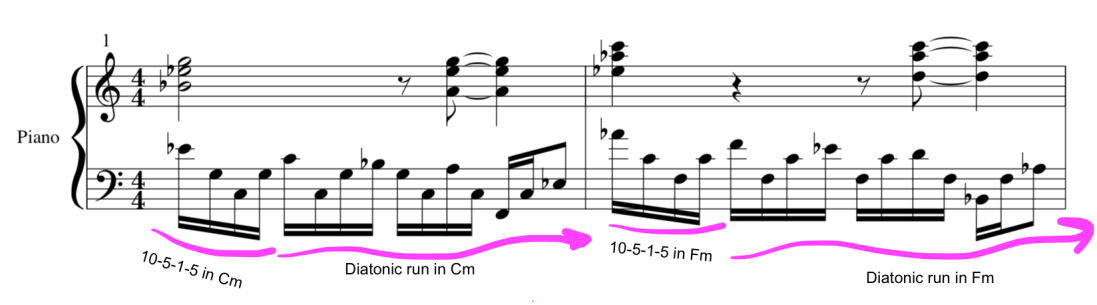
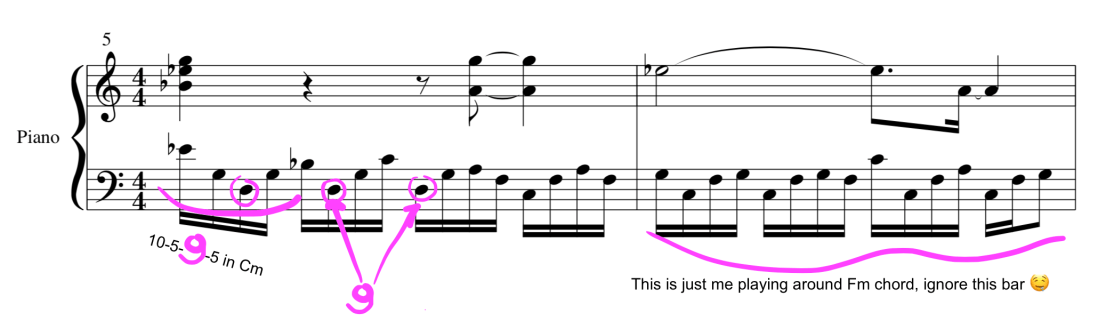
iim9 — V13 — I∆9 — IV∆ | iiø — V7b9 — m9 in C thru A, descending broken 10ths with the left hand
Harmonic minor is a bitch. Well, what I wanted to say is that it’s tricky in terms of getting fluent in it and not messing it up when you improvise. That raised 7th degree is super dissonant, it almost gives a feeling of a “wrong note” in a lot of contexts, so in order to get it properly wrong, you need to make sure your fingers remember what it is. The problem with accidentals in Hm is that the standard formulas for flats and sharps do not work, and “4 flats” does not automatically mean “Bb, Eb, Ab, Db”, as it would in any major mode. So you really need to get quick at figuring out what the 7th is and then raising it half step — or just get comfortable with all the accidentals in each key. Sounds like a lot of boring math, but I actually came up with a fun exercise that makes it sound super fancy and can turn your next practice session into a — you guessed it — extremely entertaining pastime.
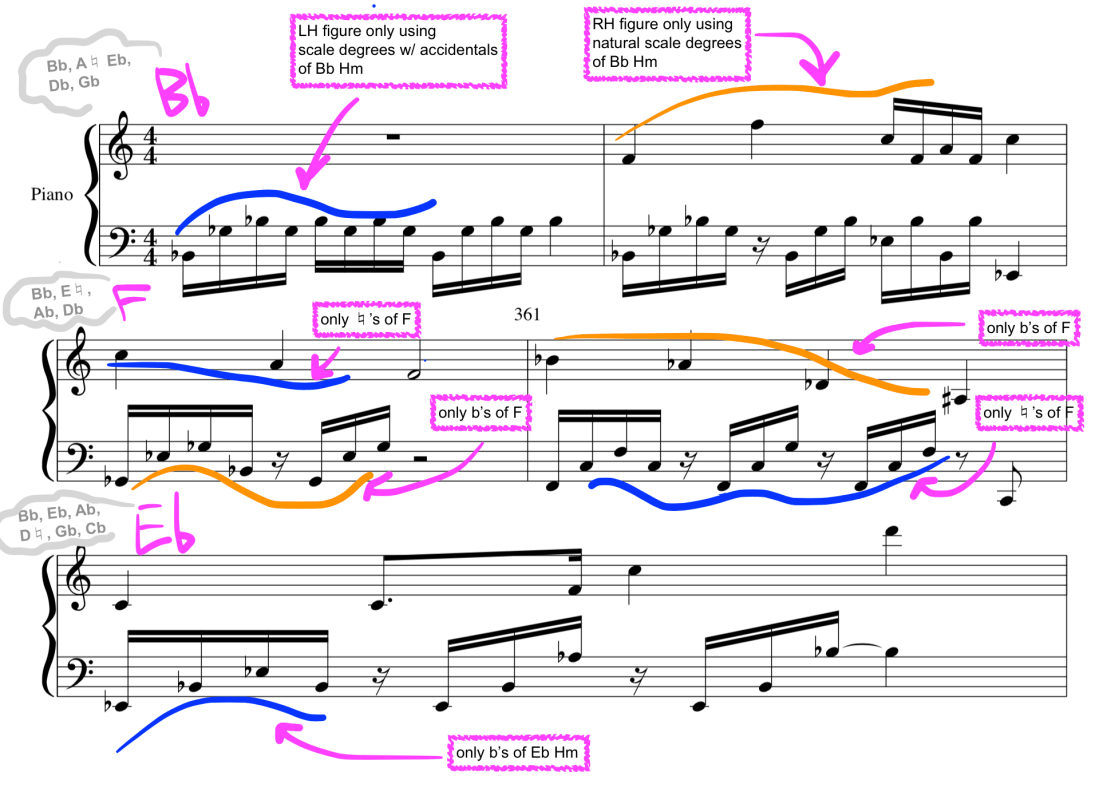
The idea is simple: one of your hands only plays scale degrees with accidentals, the other one only plays naturals — in any octave, in any combination, harmonically or melodically. That’s it! You do it for one measure, and then you change hands. If the left was playing only altered degrees, it has to switch to naturals, the right then will switch to accidentals. For the next measure, you change the key (like, go around the cycle of 4ths maybe?). Here’s an example of Bb harmonic minor going into F harmonic minor going into Eb harmonic minor:
And here’s how it sounds:
It might start sounding a bit like shit once you get to the keys with a lot of accidentals (like Eb here), but in this case, you can just turn off the restrictions and use all notes in both hands.
Oh, and yes — try in any major mode or blues scale to experience the instant gratification of not having to think about the raised 7th 😆


 Black Hole Piano