Just recently I have released a new piece that was initially written for the electric bass, but then somehow segued into the whole new world of noise music that I’ve been circling around for a long time.
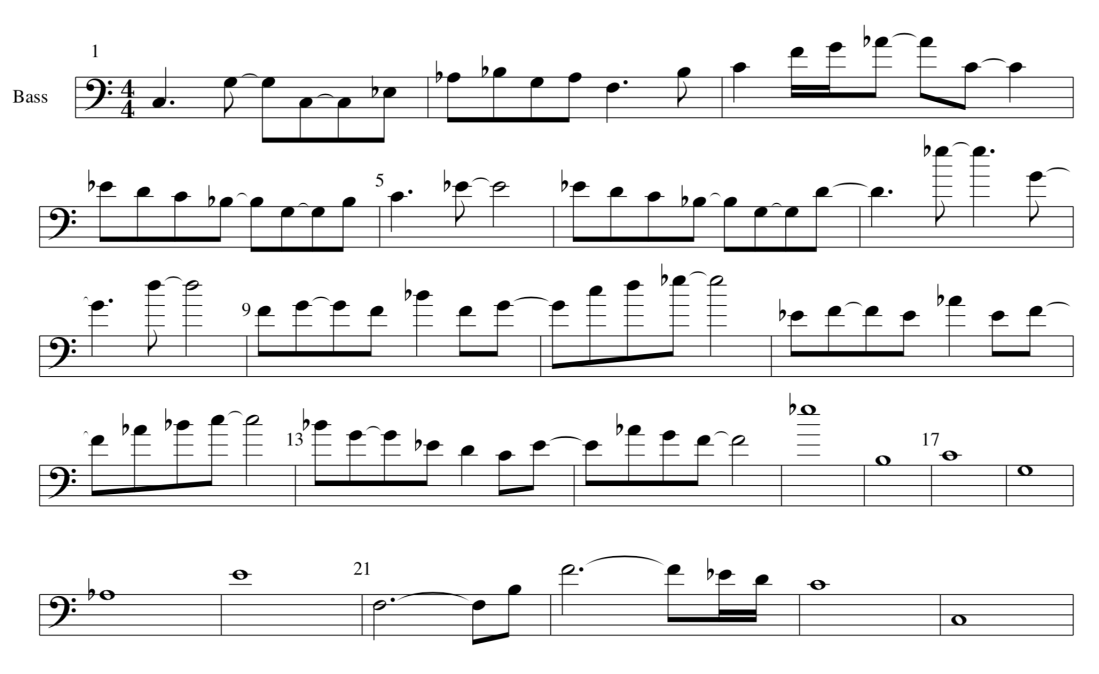
First of all, here’s the score:
You can also take a listen to it here:
And / or watch a music video for it:
Finding passing sounds for your music is almost like scoring a moving image — only on a different level. Just like certain harmonies and modalities fit certain characters and scenes in a movie, there are very specific types of sounds that are appropriate for specific melodic figures and progressions. And if you find them, and process them, and strip them of the unnecessary parts, and put them exactly where they belong in your theme — you may end up with a whole new understory that complements the piece and adds a new dimension to it.
And after you’re done with this part, you can go ahead and add a visual, effectively leaving the three-dimensional world.
I’m definitely going to explore this realm further and keep you posted about it! 🤙🏻
Hand independence is one of those technical things that I unconsciously put off for as long as I can, trying to justify it by telling myself that it’s not as important and that I’d be better off focusing on theory or learning pieces, plus it’s just plain boring and frustrating, so why start it anyway. And it’s all right until I sit down to record another piece and realise that I need 20 exhausting takes to lay down a fairly simple part because I just can’t reconcile left hand bass pattern with the melody that my right hand plays. Furthermore, because of the lack of focused work on independence, my fingers tend to avoid complex patterns and I often end up with similarly sounding, repeating melodic landscapes. So yeah, dedicated hand independence workout is important because it improves composition.
But instead of reaching for a Czerny book and embarking on a 10-year nightmare of finger exercises, I decided to make use of some jazz voicings and — as always — come up with a routine that would be fun and musical. So I could actually compose stuff in the process.
Here’s what I started with:
As you can see, the right hand simply plays notes from the shell voicing of a major 7th chord (7-3-5 in this case), while the left hand walks up and down the major 7th arpeggio (in full 1-3-5-7 form). Just breaking a shell chord voicing into individual tones already creates a pleasant-sounding line! What is the obvious next step to sex it up?
Yes:
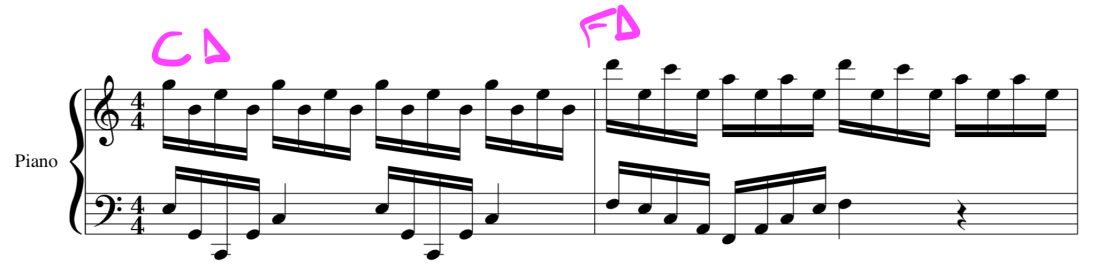
Add broken 10ths in the left hand. Alternating 10-5-1-5-10 pattern and walking ∆7 arpeggios with LH against the same line with RH already sounds super jazzy and very rich. Just in case — I’m going around the cycle of 4ths here (C∆ → F∆ → etc.) and playing corresponding 7-3-5 shells with my right hand.
Next step — try a more sophisticated intervallic pattern. I love 6ths, James Jamerson loves 6ths, why not take them?
First, isolate them and practice over descending and ascending arpeggio to let the right hand get used to the new pattern, and then — combine all left hand and right hand lines in one workout:
Here C∆ 7-3-5 figure is played over broken 10ths, and then in the next bar, the 6-5-3-7 pattern in F major is played over F∆ arpeggio. Obviously, you can continue on and go around the cycle of 4ths / circle of 5ths or a modal II—V—I.
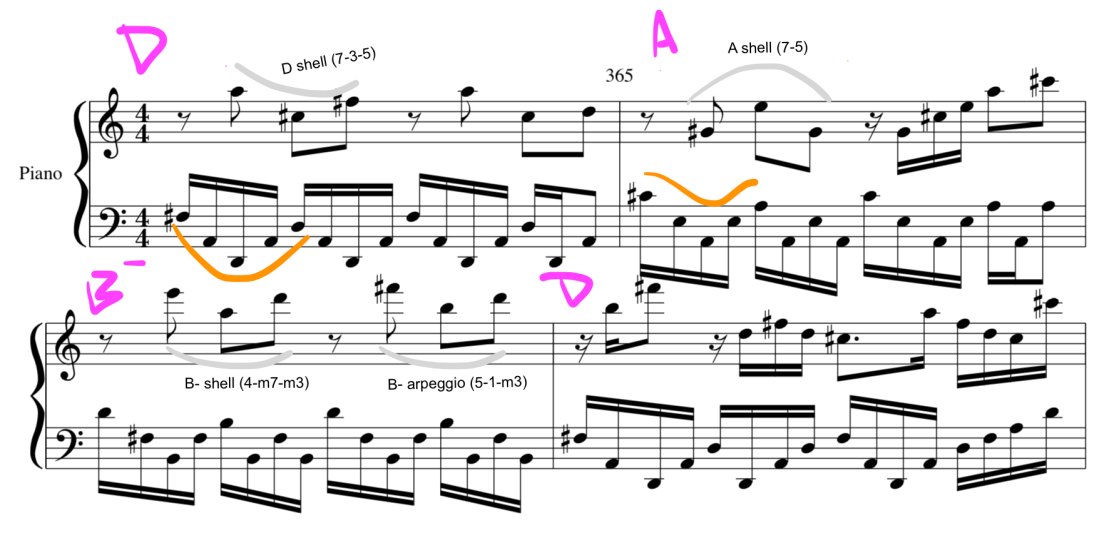
Finally, here’s an example of a real world application of the all aforementioned techniques. I took the first couple of bars of Always on My Mind by Brenda Lee (D | A | B- | D) and just improvised on them playing mostly 1-5-10, 1-5-1′ pattern with the left hand and different intervallic patterns with the right (mostly focusing on melodically played 7-3-5 shell). Check it out, I’m using colours now! Does it make notes on the staff look less (more?) annoying? 🤓
When playing from the chord chart, there is always a temptation to look on it even after you already know the progression by heart. It could be helpful to try and memorise the chords in the process of improvising to be able to look away from the chart and concentrate on introducing new left hand patterns and right hand runs.



 Black Hole Piano