More descending motion practice + making it hurt for the right hand

“I only start counting when it starts to hurt” — inspired by this Mohammed Ali quote, I decided to make it hurt (well, for my brain) during today’s practice session. I am currently focusing on descending motion in the left hand as it’s my weakness (due to the years of ignoring reverse arpeggios), but, as you know, I don’t like doing just one thing as it quickly gets boring and frustrating. So I took two of my older exercises and added some mindfuck to them to also work on right hand.

Screenshot 2019-03-24 at 10.50.05.png

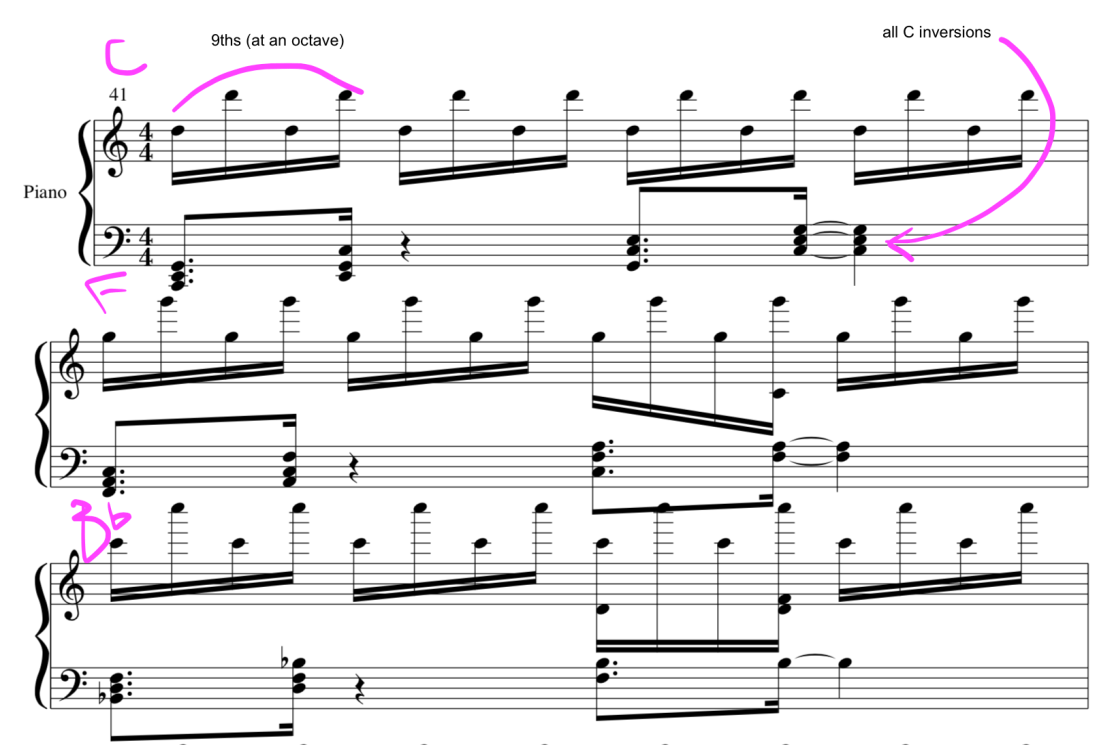
This is the continuation on the original one. I simply play 9ths over moving inversions, and because there is this panicky moment when hands are about to overlap, this version makes me think more, i. e. makes it hurt in a more effective way. Right?

Secondly, I came up with an improvement for this exercise. Now the right hand is involved, too, and it has to play the pattern that gets more and more complicated with each measure. The biggest fun for me happens in the last measure where I have to think about different scale degrees that I have to play with my left and my right hands. Yes, brain, it feels natural both physically and sonically to play C and then D with both hands, but in this case, it has to be D and then doubled Eb! (See sheet music for the explanation of this inner dialogue.)

Screenshot 2019-03-24 at 11.01.11

Practicing extensions & inversions without boring yourself to death

Today I wanted to share another approach to practicing such seemingly technical and tiresome stuff as chord inversions and extended intervals. I keep trying to make all my routine musical and as close to real life situation as I can. It may be useful to spend 5 hours throwing all inversions of all 7th chords in all keys in all modes around the circle of 5ths, but sometimes you just want your exercises to be a bit more musical. You know what I mean? So I did that.

Screenshot 2019-03-10 at 13.31.19.png


This is, in fact, a combination workout. Left hand plays all the inversions of a block chord, right hand plays diatonic interval or extension of choice (in this case major 7th) in two octaves. I’m still going around the good ol’ cycle of 4ths, but it sounds already like a piece and has much less of that endless ii — V — I feeling in it.

The beauty of it is that the moment you start getting bored, you can pick a different interval, just like that:

Screenshot 2019-03-10 at 13.07.40.png

…and Bob’s your uncle — now you’ve got completely different flavour as 9ths blend with inversions in the left hand.

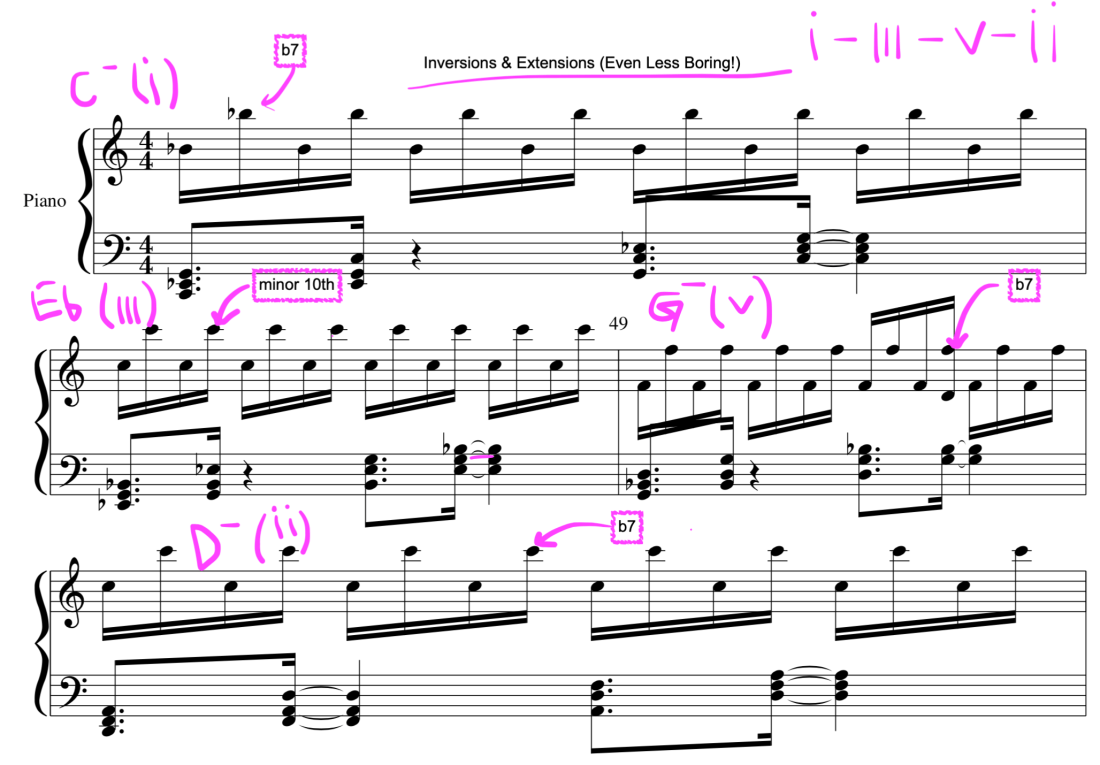
But the cycle of 4ths motion is still there, so it’s just a question of time before you will have had enough of it, right? 😄 That’s where modal progressions come in! And don’t forget that you can also alternate intervals in the right hand. Here I took C Dorian progression that sounded particularly nice to me: i — bIII — v — ii and applied the same technique while playing it. It sounds definitely like a piece, and in no way like a dull exercise.

Screenshot 2019-03-10 at 23.16.07

Obviously, then there’s Real Book and all the good stuff. You got it—

Piano day (1h 40m)

Voicings + left hand

Scale studies

  • All Locrian scales

Comping

  • Comping over Worth the Wait in D to the walking bass & drums backing track in iReal
    • Avoiding roots and block in LH
    • Voice leading / smooth shells transition in RH
    • A little bit of soloing
    • Trying to avoid clashes w/ bass