More descending motion practice + making it hurt for the right hand

“I only start counting when it starts to hurt” — inspired by this Mohammed Ali quote, I decided to make it hurt (well, for my brain) during today’s practice session. I am currently focusing on descending motion in the left hand as it’s my weakness (due to the years of ignoring reverse arpeggios), but, as you know, I don’t like doing just one thing as it quickly gets boring and frustrating. So I took two of my older exercises and added some mindfuck to them to also work on right hand.

Screenshot 2019-03-24 at 10.50.05.png

This is the continuation on the original one. I simply play 9ths over moving inversions, and because there is this panicky moment when hands are about to overlap, this version makes me think more, i. e. makes it hurt in a more effective way. Right?

Secondly, I came up with an improvement for this exercise. Now the right hand is involved, too, and it has to play the pattern that gets more and more complicated with each measure. The biggest fun for me happens in the last measure where I have to think about different scale degrees that I have to play with my left and my right hands. Yes, brain, it feels natural both physically and sonically to play C and then D with both hands, but in this case, it has to be D and then doubled Eb! (See sheet music for the explanation of this inner dialogue.)

Screenshot 2019-03-24 at 11.01.11

Descending motion is important, too!

Just realised that since I have discovered broken 10th patterns, I’ve been focusing heavily on ascending motion, almost completely ignoring the descending part. Here’s a workout that I’ve recently come up with to make up for that.

Left hand plays descending 10-5-1 pattern and then also continues with descending pattern of diatonic intervals alternating with the root. Doing it around the cycle of 4ths, as always!

Screenshot 2019-03-23 at 10.07.17

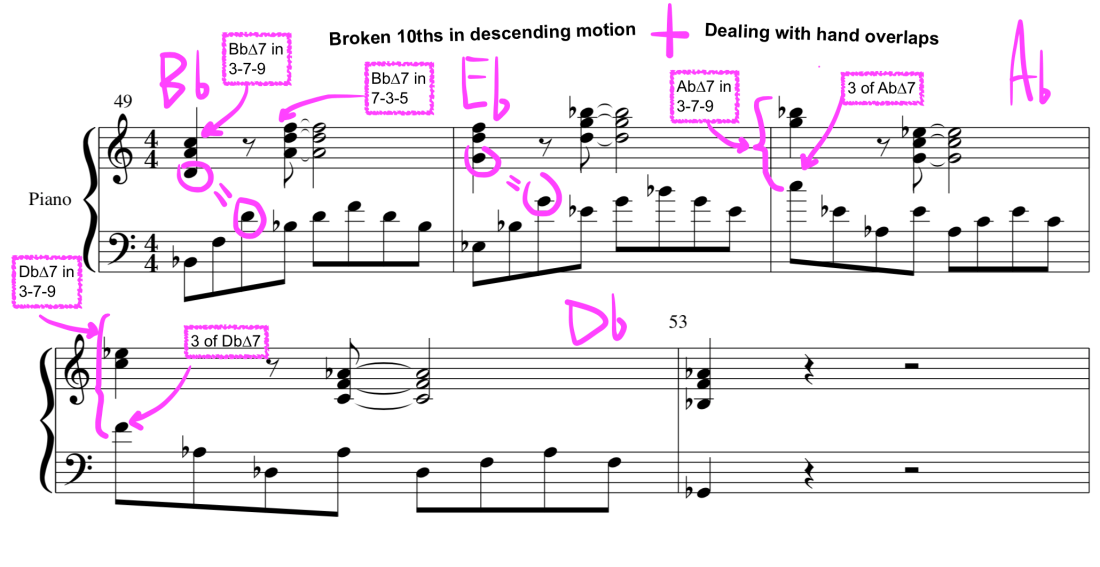
Then, of course, there’s the Fear Of Overlapping™ that has to be addressed — also in the context of descending motion. So here’s another exercise that does the job for me:

Screenshot 2019-03-23 at 10.43.10.png

Here I’m doing the same trick with alternating voicings (3-7-9 to 7-3-5) and forcing the left hand to play the same key as the right within one measure. I wrote about this here a little bit more in-depth.

Piano day (1h 30m)

Scale studies

  • All Phrygian scales
  • All Aeolian scales
  • All Phrygian scales in 3rds with moving chords (DNA)

Left hand + jazz voicings

  • Skill 44 from Jazz Piano Voicings by Dan Haerle (ii — V9 — I∆7 — IV∆7 | iiø — V7b9 — i) with left hand playing 10ths & triad arpeggios octave above in all keys (all keys mate!)