Practicing extensions & inversions without boring yourself to death

Today I wanted to share another approach to practicing such seemingly technical and tiresome stuff as chord inversions and extended intervals. I keep trying to make all my routine musical and as close to real life situation as I can. It may be useful to spend 5 hours throwing all inversions of all 7th chords in all keys in all modes around the circle of 5ths, but sometimes you just want your exercises to be a bit more musical. You know what I mean? So I did that.

Screenshot 2019-03-10 at 13.31.19.png


This is, in fact, a combination workout. Left hand plays all the inversions of a block chord, right hand plays diatonic interval or extension of choice (in this case major 7th) in two octaves. I’m still going around the good ol’ cycle of 4ths, but it sounds already like a piece and has much less of that endless ii β€” V β€” I feeling in it.

The beauty of it is that the moment you start getting bored, you can pick a different interval, just like that:
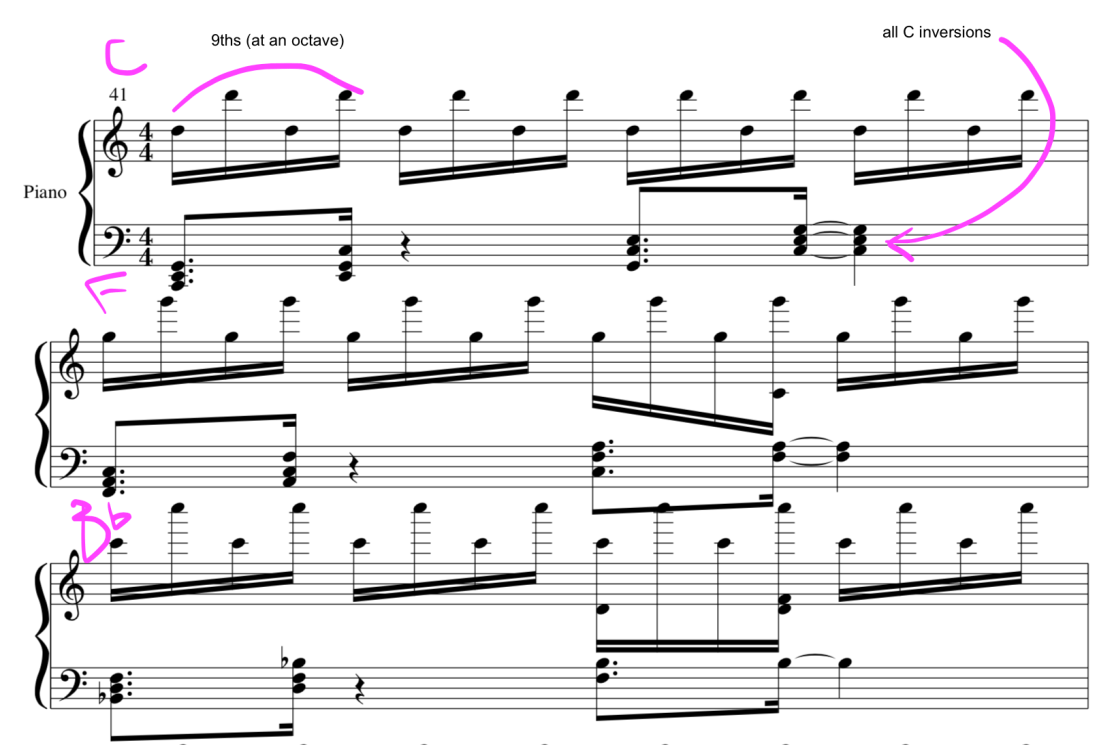
Screenshot 2019-03-10 at 13.07.40.png

…and Bob’s your uncle β€” now you’ve got completely different flavour as 9ths blend with inversions in the left hand.

But the cycle of 4ths motion is still there, so it’s just a question of time before you will have had enough of it, right? πŸ˜„ That’s where modal progressions come in! And don’t forget that you can also alternate intervals in the right hand. Here I took C Dorian progression that sounded particularly nice to me: i β€” bIIIΒ β€” v β€” ii and applied the same technique while playing it. It sounds definitely like a piece, and in no way like a dull exercise.
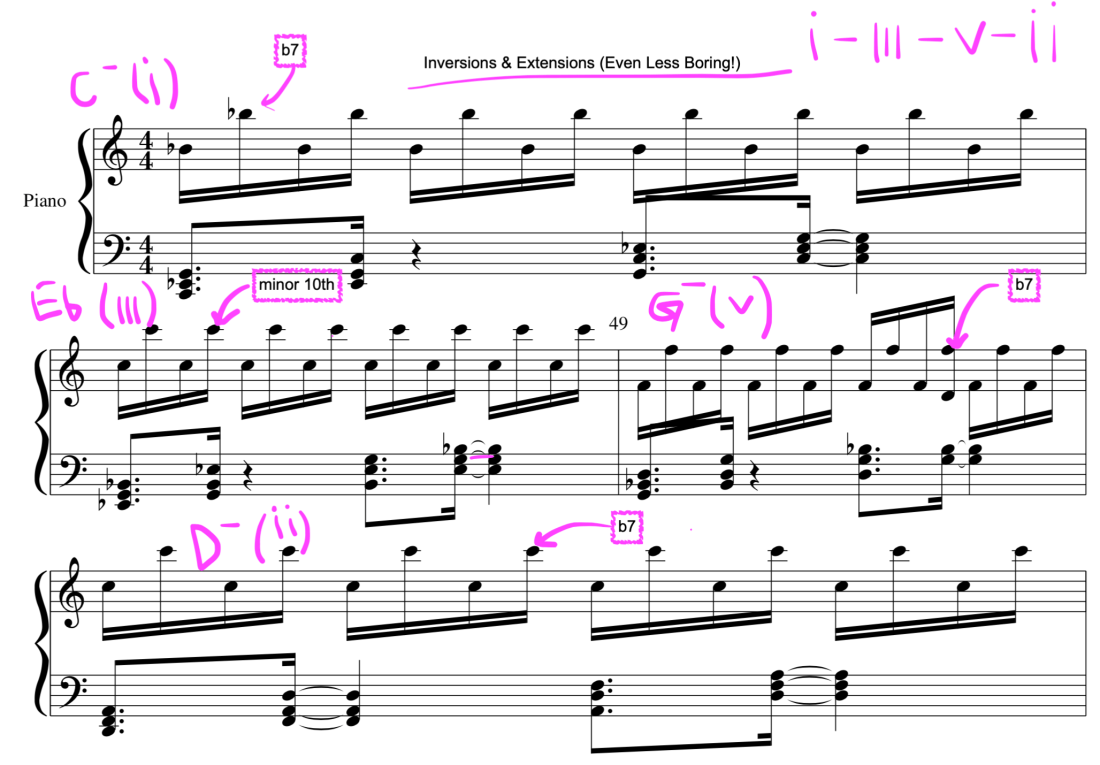
Screenshot 2019-03-10 at 23.16.07

Obviously, then there’s Real Book and all the good stuff. You got itβ€”

Piano day (1h 40m)

Voicings + left hand

Scale studies

  • All Locrian scales

Comping

  • Comping over Worth the Wait in D to the walking bass & drums backing track in iReal
    • Avoiding roots and block in LH
    • Voice leading / smooth shells transition in RH
    • A little bit of soloing
    • Trying to avoid clashes w/ bass

Making chord voicing practice more musical

I use jazz voicings a lot in my routine. Dan Haerle’ s book Jazz Piano Voicings was the huge one for me β€” discovering chord shells opened the whole new world for me, and I’m still digging through it almost every session. But at some point you may find that simply taking a pair of voicings around the cycle of 4ths (or circle of 5ths) could be a bit boring and, well, its musicality wears out as you get used to the sound of these chords.

I try to keep my exercises musical (following Rick Beato’s advice), so I always combine Mr. Haerle’s skills with different left hand patterns. Currently I’m practicing broken 10ths and other extensions, so I use them as an accompaniment as I go around the circle, and sometimes throw in some block chords (in order to not to get lost in intervals). It embellishes the overall sound and allows me to work on both hands’ technique at the same time. Smarty pants, huh? Here’s what I mean.

Screenshot 2019-03-08 at 21.37.53.png


Piano day (1h 40m)

Scale studies + technique

  • Chromatic scales
    • Similar motion, at an octave
    • At at 3rd
    • At a major 6th
    • At a minor 6th
    • Contrary motion, at a 3rd
    • Alternate / legato fingering

Voice leading + shells

  • ii β€” V7 β€” I β€” IV in major & parallel minor (m7 β€” 7/9 β€” maj7 β€” maj7/9 | ΓΈ β€”7b9 β€” m7)

Left hand + combination workout