How to deal with mad accidentals in harmonic minor modes

Harmonic minor is a bitch. Well, what I wanted to say is that it’s tricky in terms of getting fluent in it and not messing it up when you improvise. That raised 7th degree is super dissonant, it almost gives a feeling of a “wrong note” in a lot of contexts, so in order to get it properly wrong, you need to make sure your fingers remember what it is. The problem with accidentals in Hm is that the standard formulas for flats and sharps do not work, and “4 flats” does not automatically mean “Bb, Eb, Ab, Db”, as it would in any major mode. So you really need to get quick at figuring out what the 7th is and then raising it half step — or just get comfortable with all the accidentals in each key. Sounds like a lot of boring math, but I actually came up with a fun exercise that makes it sound super fancy and can turn your next practice session into a — you guessed it — extremely entertaining pastime.

The idea is simple: one of your hands only plays scale degrees with accidentals, the other one only plays naturals — in any octave, in any combination, harmonically or melodically. That’s it! You do it for one measure, and then you change hands. If the left was playing only altered degrees, it has to switch to naturals, the right then will switch to accidentals. For the next measure, you change the key (like, go around the cycle of 4ths maybe?). Here’s an example of Bb harmonic minor going into F harmonic minor going into Eb harmonic minor:
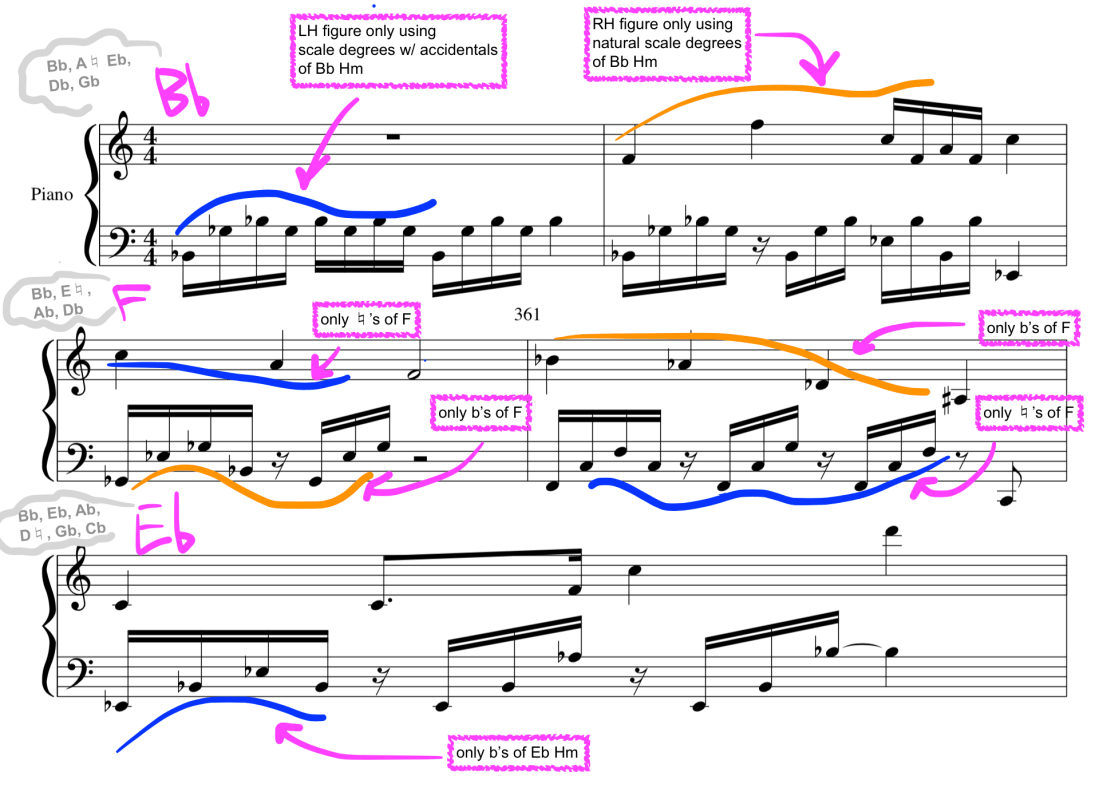
Screenshot 2019-04-06 at 1.44.56 PM.png

And here’s how it sounds:


It might start sounding a bit like shit once you get to the keys with a lot of accidentals (like Eb here), but in this case, you can just turn off the restrictions and use all notes in both hands.

Oh, and yes — try in any major mode or blues scale to experience the instant gratification of not having to think about the raised 7th 😆

Till later—
Practice session: harmonic minor and rootless broken 10ths

Scale studies

  • All Hm1 scales

Left hand

  • Broken 10ths recap: Dorian DNA (i7 — IV) in all keys
  • Descending motion focus: rootless broken 10ths
  • Having some classical time: all minor 7th arpeggios in descending motion

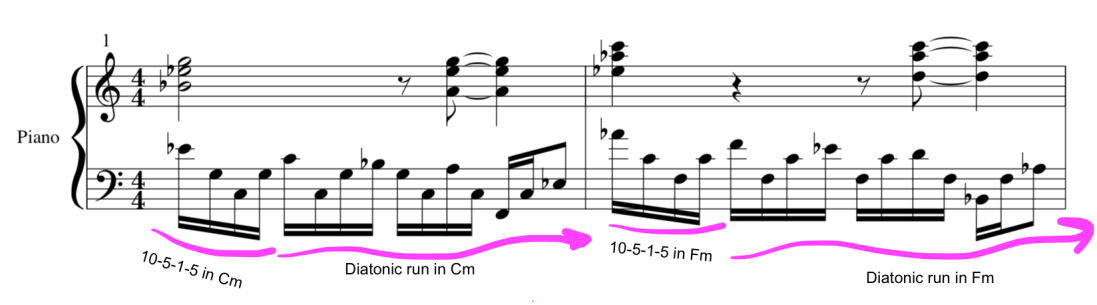
What do I mean by “rootless broken 10ths”? 🥴

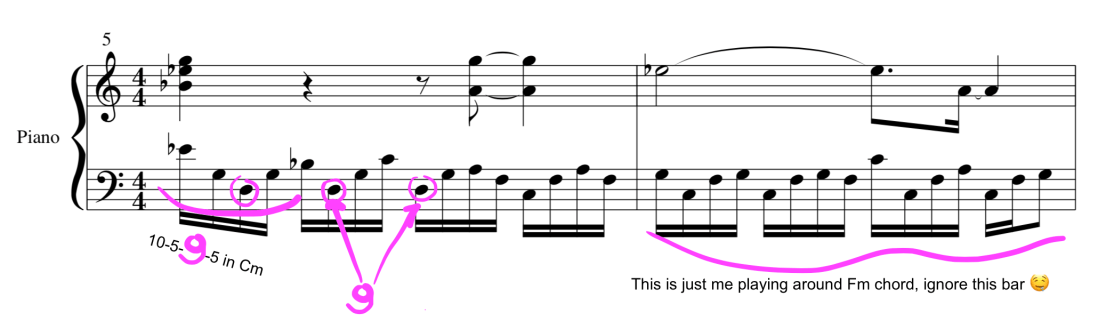
These are normal broken 10ths with some diatonic line (going from Cm to Fm):

Screenshot 2019-04-06 at 2.38.11 PM.png

Here, I’ve just replaced 1s (C) with the 9ths (D) to get a super sexy sound of a 9th played below. Give it a try (and ignore the second measure):

Screenshot 2019-04-06 at 2.47.59 PM.png

Session timing: 1h 45m

Practice session: scale dissection and revisited ii — V — I’s

Scale studies

Jazz voicings + left hand

Observations

Scale dissection is getting much better, but still sucks in Bb- and other keys with a lot of accidentals, where the “white are 1 & 2, black are 3 & 7” pattern is not there anymore. This is why visual pattern are shit! To take a slightly better thought-through analogy, they are like sugar — addictive and unhealthy! 😄

Session timing: 1h 40m

Becoming a scale monster

Last week I’ve shared a non-boring scale hack that is supposed to turn the scale studies that are often viewed as boring and mechanical into an — quoting Dan Haerle — extremely entertaining pastime. I am using it all the time, and just recently I’ve come up with a new workout that could be viewed as a sequel to the original one. Word of warning: its efficiency in terms of fucking up your brain and your finger muscles has improved exponentially. This is why I called it The Scale Monster.

At some point in my bass training I have been introduced to the concept of chord permutations. Basically, it’s just pure math: you have a 7th chord arpeggio, and there are 24 ways to play these notes in a sequence. Not a big deal, right? Later, you realise that you can then take all inversions of this chord and permutate them. Which will give you 96 sequences. Which you will then transpose to all keys and circle around all the modes and create all the Western music.

Of course, it would be crazy for a human to just mechanically practice this hell (although it does improve your fluency tremendously). Instead, you can just use it as a pool of pre-generated patterns to sex up your routine!

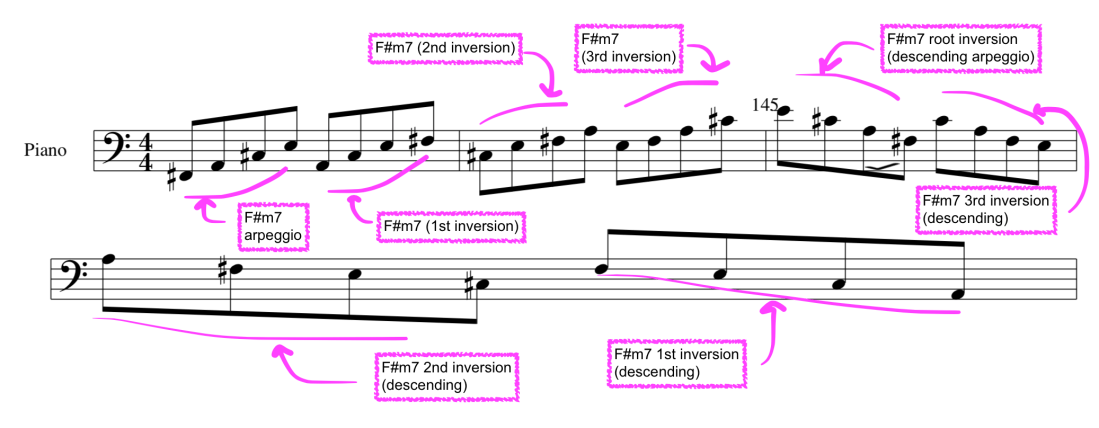
Check it out — this is just a regular F#m7 chord played consequently in all inversions:

Screenshot 2019-04-03 at 20.08.34.png

Easy, right?

Going on — F#m7 in all permutations starting on 1:

Screenshot 2019-04-03 at 20.15.51.png

Personally, I just like how it sounds. There is no trace of that worn-out minor arpeggio sound that so many other people are practicing at this very moment all around the world. Yes, it’s a bit robotic — but — we’ll fix that in a sec.

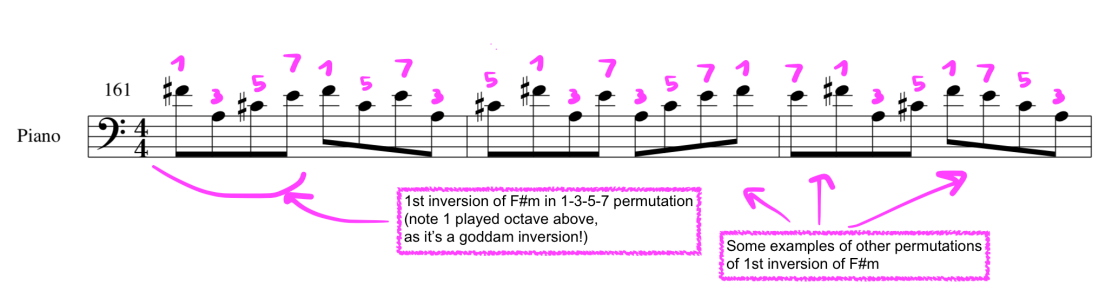
Next — my “aha!” moment: 1st inversion in different permutations:

Screenshot 2019-04-03 at 20.21.48.png

Note that permutating the inversion does not give you the same results as permutating the original chord, as the root (aka 1) is transposed one octave above. So it’s a completely different set of combinations.

As a next step, I’m going to take one permutation of choice (1-3-5-7 in this case) and play all inversions of my F#m7 using it — ascending, then descending:

Screenshot 2019-04-03 at 20.32.29.png

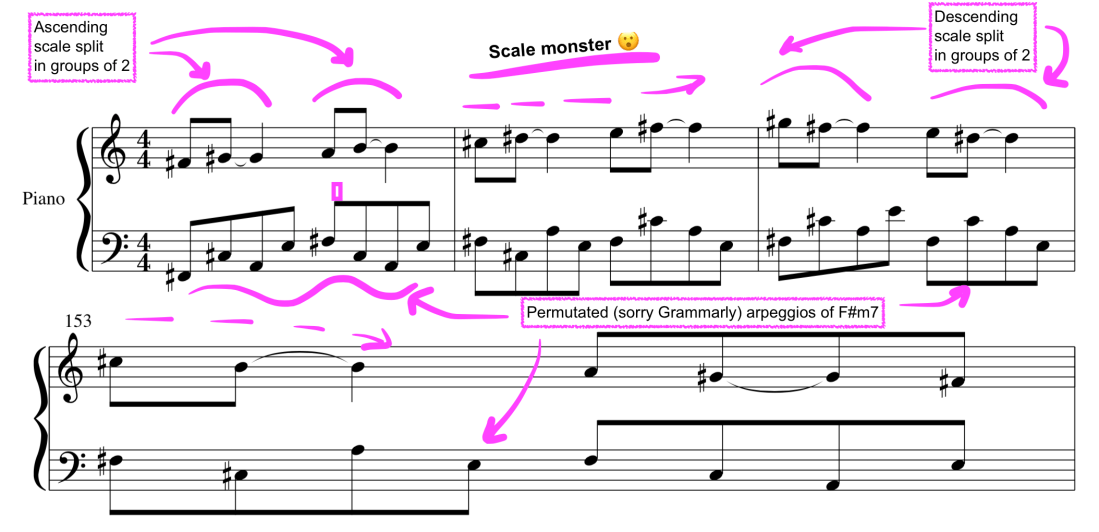
And finally, add the right hand that is going to play the F# Dorian scale dissected into groups of 2 notes:

Screenshot 2019-04-03 at 20.42.13.png

If up until this point you were only mildly challenging the part of your brain responsible for scale fluency, now’s the moment when you finger independence gets fucked up big time! 🤓

Not all of it might sound great — as particular permutations might create dissonant intervals with scale degrees, but that only means that you can spend another two hours trying out other ones figuring out the best combination. And — remember — it was only F# Dorian over F#m7. Sooo… You get the idea 🤙🏻 Harmonise ’till it hurts! Till next time—