Comment j’apprends

Long time no see, huh! Sorry about the relatively long gap between the posts — I am currently rehearsing the tracks for my new EP, and it takes pretty much all of my time (which is the issue that might — and should — be addressed by proper practice 🤓)! Anyway — today I wanted to share a part of my workflow concerning the jazz books: how I use them, adapt them to my (sometimes not-so-jazzy) needs and make them work together with other practice routines that I have.

Here’s one of my long-time favourites: Jazz Piano Voicing Skills by Dan Haerle, one of the world’s most renowned jazz educators and pianist (he’s retired from his university job, but he’s still touring with his trio, by the way!). It’s the book that opened the Pandora’s box of 13th chords voicings — all that 7-3-5, 3-7-9, 7-3-6, all the polychord and fourthy stuff that I keep going on about here — it’s from Mr. Haerle. If you’re just starting your journey from the block chords to the new horizons, I would recommend getting this book, closing your browser tab and just diving in it for a couple of months — it will take your playing to the next level, no shit 🤭

So, back to today’s topic — here’s an excerpt from the book:
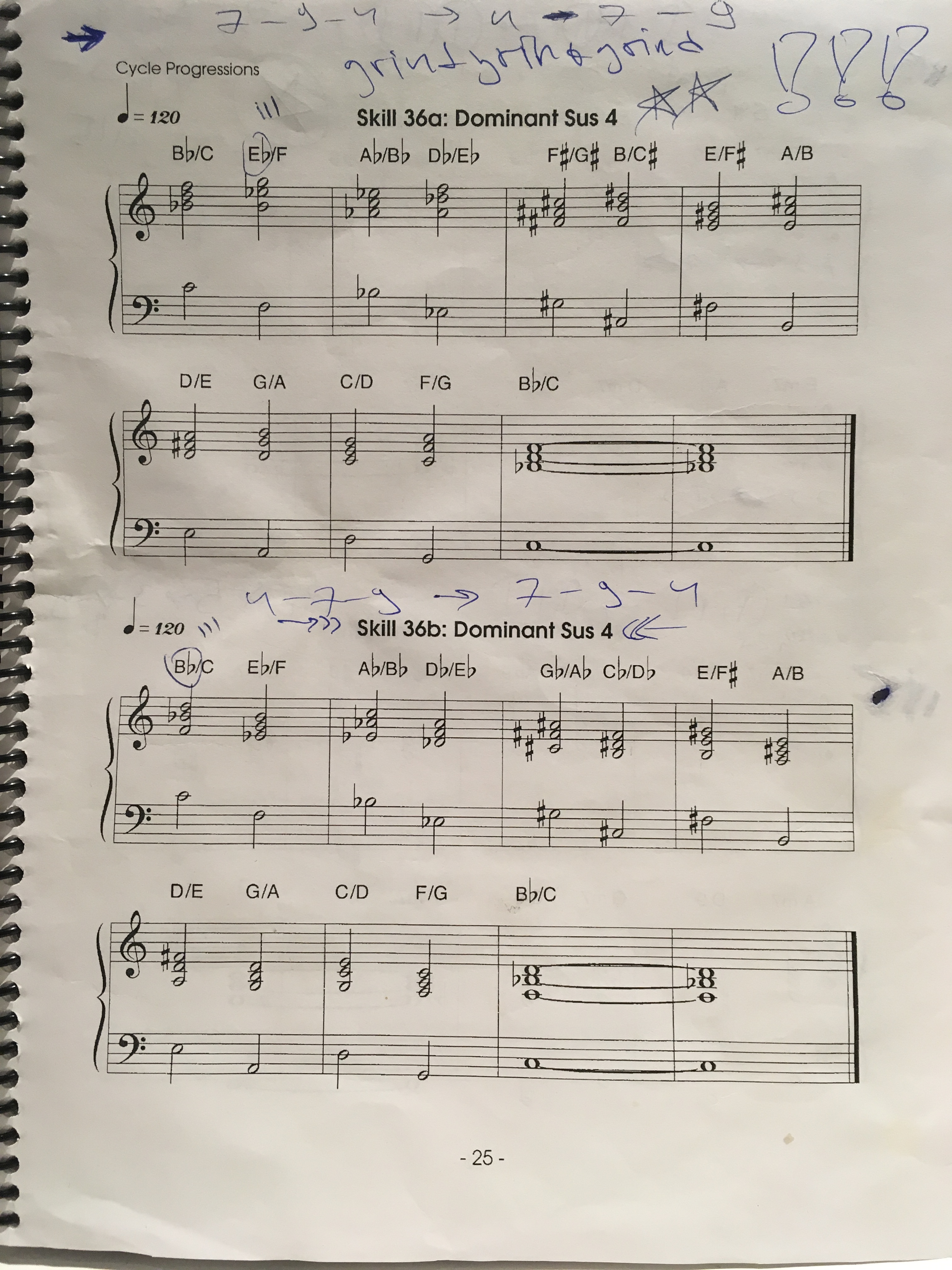
IMG_1268.JPG

All exercises there are called “skills”, and what they are is basically different types of 7th or 13th chords moving around the cycle of fourths while using the smart voice leading to ensure minimum finger movement. Sometimes the quality of the chord will also change, but in this case, it’s just the dominant chords with suspended 4ths, the left hand plays the root, and the right plays 7-9-4 → 4-7-9 pattern. You can also see that the marks that I leave in my paper books look exactly the same as the ones I have in my own sheet music here 😆

Okay, so, this is a great exercise, but after a while, it kind of gets too simple, particularly because of the left hand only playing the tonic. How can we improve that?

Screenshot 2019-06-16 at 9.47.01 PM.png

Of course! Instead of playing just the tonic — I’m going to play the full block chord with the left hand, which will give me the full dominant polychord sound and a very satisfying sentiment of being smarter than the jazz book. But chords are boring. Let’s arpeggiate things!

Screenshot 2019-06-16 at 10.18.22 PM.png

Just doing the same thing, only I added some eighth notes and shells to the left hand pattern. Only using the notes of the corresponding dominant 7th chords (C7 & F7) here. What’s next? Extensions, obviously! How about extending the left-hand pattern one octave lower and adding major 10ths?
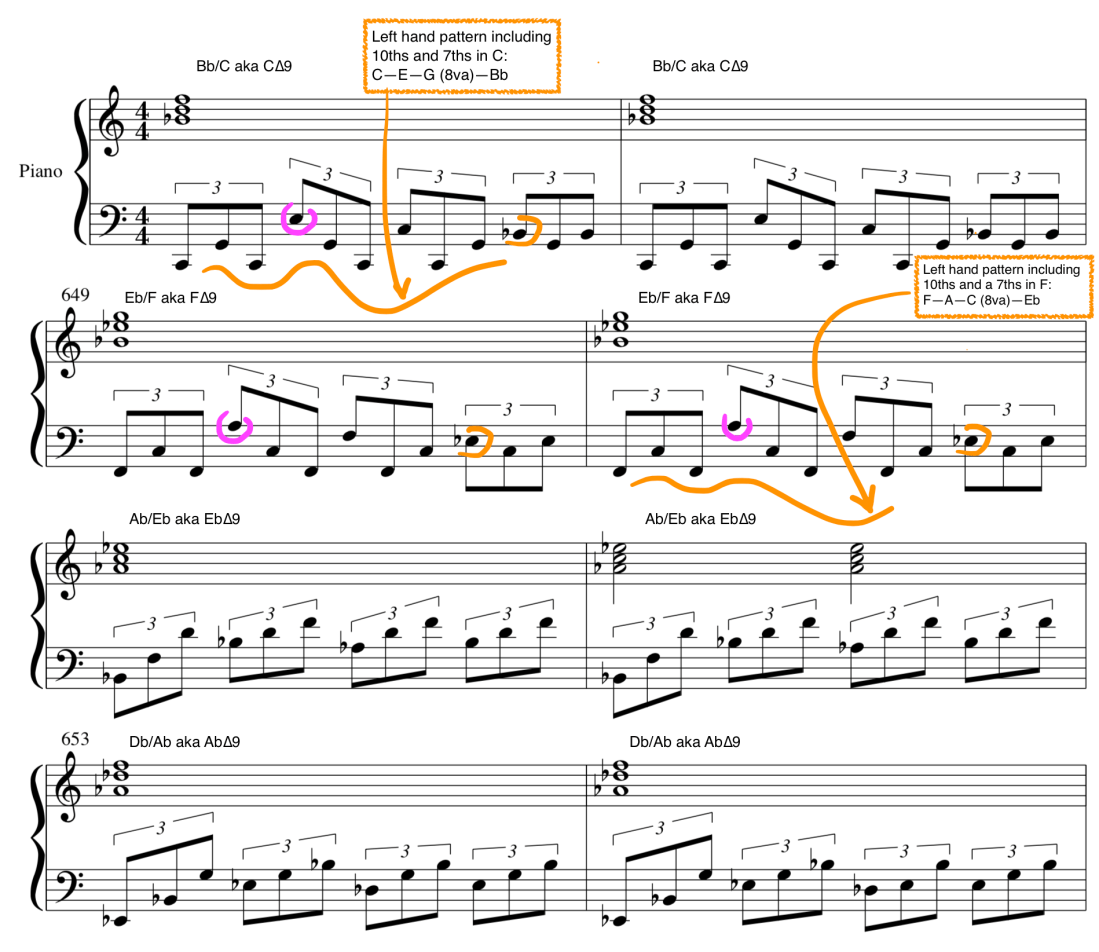
Screenshot 2019-06-16 at 10.05.36 PM.png

I’ve probably said it too much already, but just for the record — broken 10ths in piano is like ollie in skateboarding: once you’ve mastered them, you have access to all the crazy tricks out there. I have all kinds of posts on 10ths here, check them out if you want.

Next stop?

Screenshot 2019-06-16 at 10.41.55 PM.png

Here, I’ve added one of my new favourite bass patterns that is based on so called “8-to-the-bar bass” that has been used a lot by stride pianists like Willie Smith. I learned it recently from the brilliant book Jazz Piano: The Left Hand by Riccardo Scivales. I’m definitely going to write a separate post to this topic, as it is extremely interesting. But for today, I think that’s it. I love jazz books (although I am not necessarily a jazz pianist), and this the way I incorporate them in my practice routine. Hope you found it helpful too! Thanks for reading and — till later! 🎹

Perpetuation — new track & sheet music

Salut! I’ve been busy recently rehearsing and recording a new piece that is called Perpetuation and is inspired by the déplacements that I undertook in recent time.

I often feel that there is a certain — poorly identifiable — substrate that somehow lurks behind everyday pictures. Although at times it does come very close to the surface of the wordable world where you could harpoon it with one right term — especially on those sunny summer weekends when you sit around on an empty tennis court or walk down the street to the supermarket — yet, it never really reveals itself fully, thus leaving you with a bunch of almost-there definitions. I know you know what I am talking about, and that’s exactly why I am going to shut up now and give you the link to the track and sheet music to download 🎼

See you in a practice session!

Download full score as PDF

How to practice basic sh*t and sound fancy while doing it

Got an intense workout for you today! In case you’re still struggling with inversions — maybe they’re something you’ve brushed over earlier and now it seems almost embarrassing to go back and invest time in such a BASIC thing that, obviously, every two-year-old can play without a second thought (right?). I mean, that’s my case. I’ve always been too cool for triad inversions, that’s why I still mess them up in the middle of the piece and that’s why I’ve come up with this workout that would hopefully also help other people who are in the similar awkward situation. Want to practice basic shit and sound cool? Here’s the way.

Before I proceed to the sheet music — just a side note: this is, in fact, the third workout in the series that I started last year, so feel free to check the previous variations (they might sound a bit less fancy, but should be easier to play):

Inversions & Extensions I
Inversions & Extensions II

Now on to the new one:

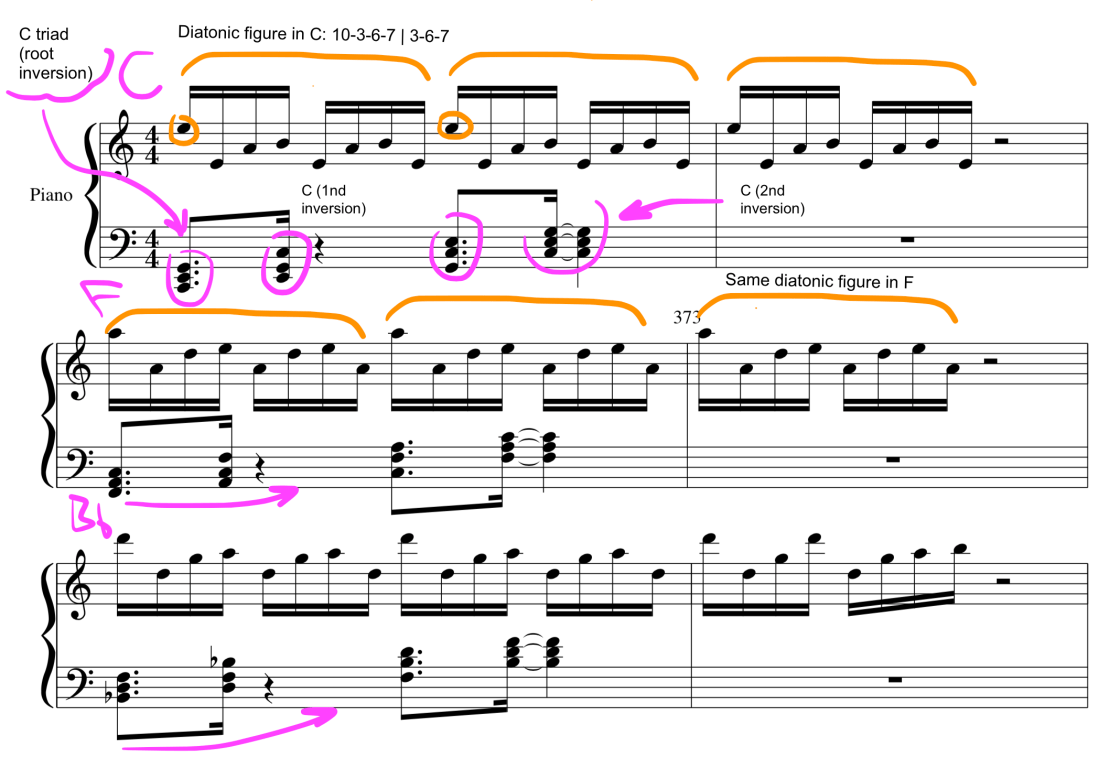
Screenshot 2019-06-02 at 9.13.08 PM.png

Here I’m combining two technical skills to take the dull, mechanistic element from the seemingly boring routine and make it sound musical and actually make practice enjoyable. That’s the goal of this blog, in case you didn’t know! 😄 In this exercise, the right hand plays moving inversions of the major triads: root — 1st — 2nd — root again, while the left plays the melodic pattern consisting of diatonic intervals. I’ve chosen major 3rds, 6ths, 7ths as the “colour” tones and added my favourite extension: the 10th (the 3rd octave up, in other words) that is known to instantly make everything sexy and jazzy. Just playing this figure over moving inversions already sounds like music, and not like aimless inversion drill.

What’s next?

Screenshot 2019-06-02 at 9.27.33 PM.png

Yeah! I took the whole thing and played it around the cycle of 4ths (here I randomly start on E major and go to D major for demonstration purposes; you can go all the way from C if you wish). The main enrichment here is that instead of one diatonic pattern (10-3-6-7), I’m playing two, emphasising the 7ths and the 6ths. It introduces some diversity (right when you need it) and is actually so fun to play that you would be willing to cycle it all day! Take a listen:


There are, of course, countless ways to embellish and extend this routine, but I’ll just briefly cover one more:

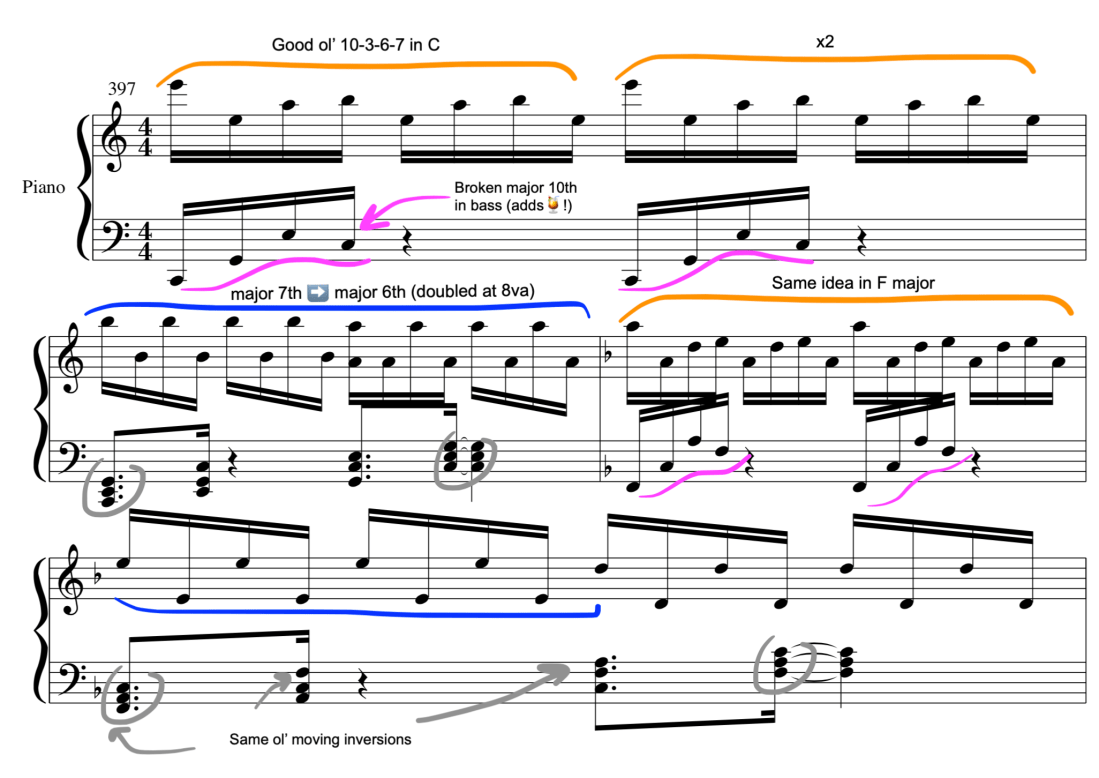
Screenshot 2019-06-02 at 9.34.30 PM.png

What should you do when adding major 10ths does not make your line any sexier? That’s right: add more major 10ths in bass! Here, I am not changing the right hand pattern, but rather employing a new device in the left hand to make the overall sound less monotone and piano practice-y. It works! Here’s an audio fragment:


Okay, that’s it for today, I hope it was helpful! Feel free to comment and add your suggestions or share practice tips. I’m also trying to make the posts a little more— er— clickable, shall I say? — by adding the audio clips of the passages that I list here, so you could get an idea of what’s going on right away, before even trying it at the keyboard. Let me know if it’s helpful. And — harmonise ’till it hurts! 🤙🏻

Modal scales: aim not to become fluent, but rather a native

In the previous post I’ve shared another non-boring way to fall in love with a scale that might sound intimidating, dissonant or uncommon (or is labelled by people as such). Like a Locrian modal scale. Recently I’ve been doing some recap and used this approach with Mixolydian mode. And it turns out it works beautifully there as well!

As always, the point of doing these studies for me is to really internalise the hallmark mood of a particular mode. Major and minor (both harmonic and natural) are almost like the kids you grew up with, right? You can finish most typical runs and progression before they end. The major scale is so predictable you’re getting nauseous halfway around the circle of 5ths. But whenever you switch to the modal world, be it major mode or harmonic minor mode, or a melodic minor mode, or some exotic non-heptatonic thing, it immediately starts to feel “unfinished”. Like, why does the Lydian mode sound as if it were questioning something? Who’s Phrygian angry at? And why does Mixolydian suddenly feel annoyingly round and overly clean, like a badly photoshopped fashion model?

So, this feeling of “wrongness” and peculiarity — as opposed to instinctive nature and obviousness that you have with major and minor — apparently originates from the fact that you might not have had a chance to hang out with those modalities and make friends with them. It’s somewhat reminiscent of foreign language phonetics that sound funny — but a little more subtle. Well, there’s a way to alleviate this problem and learn to accept modal scales as they are — by dissecting them!

Here’s the same approach that I used to tame Locrian mode — applied for Mixo (you can find the detailed description in the previous post):

Screenshot 2019-05-27 at 10.25.29 PM.png

Starting with simple arpeggiated modal 7th chords.

Screenshot 2019-05-27 at 10.25.53 PM.png

Moving on and adding the Mixolydian scale (F in this case) dissected in groups of 3, ascending and then descending over the moving arpeggios, thus producing the unique blend that gives you a much fuller impression of the mode compared to just bluntly rolling up and down the scale.

Screenshot 2019-05-27 at 10.25.40 PM

And finally adding the octave jumps to challenge the right hand and add even more definition and depth to the picture. That’s it! Gotta keep it short, as I’ve probably already been dragging on this topic a little bit too long. Make sure to check out other dissection posts, and tune in back later for the new (hint: left hand) stuff!


Falling in love with Locrian

Locrian mode is the one most people tend to avoid. The mad one. The psycho. Everyone knows it under different pejorative names but the thing is — almost all theory teachers bash it and label it as “dissonant” or “not too widely used”. Well, maybe the fact that it’s not that widely used is the direct consequence of its ostracism in pop culture (I ain’t talking about jazz here!).

I used to avoid it as well and kept postponing its studies using all kinds of excuses. And then one day— Want to hear a secret? Locrian is, in fact, the most beautiful and sexy and extra tight / please don’t go there / just say the best / of all major modes — and in order to realise this, you only need to get over its diminished first degree! Once you fall from  right into the arms of bII∆7, you’re in love with it forever.

To make this realisation as simple as possible — and also to discover the hidden beauty of this freaky scale, I applied my dissection approach to it and here’s — I’m getting to the point — here’s the exercise I’d ended up with!

Screenshot 2019-05-20 at 10.23.43 PM.png

Yes, I used C# key intentionally — mostly because it’s just fun to get out of C basecamp sometimes, no? 🤔

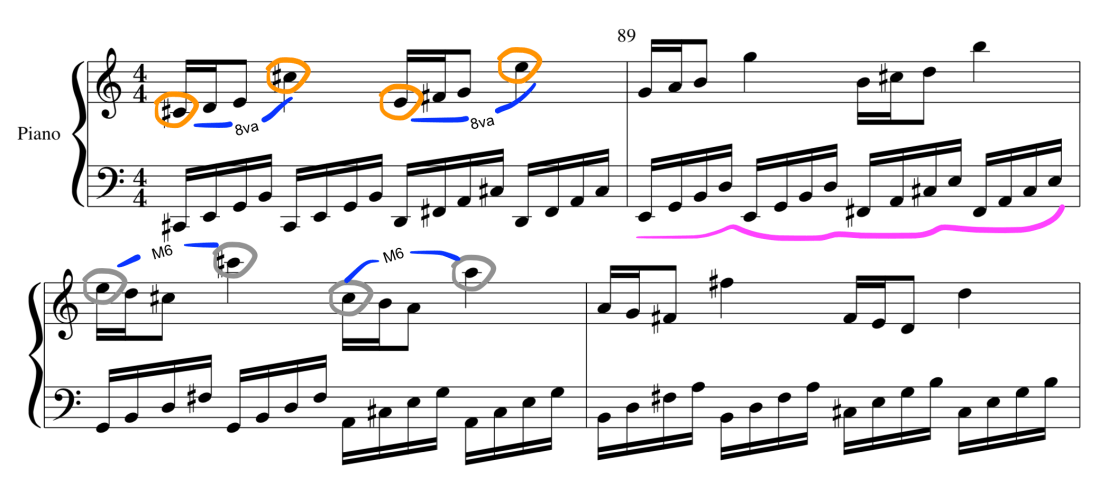
So, left hand here plays the simple 7th arpeggios of the harmonised C# Locrian scale: C#ø7 — D∆7 — Em7 — etc., and is then joined by the right hand that goes up the same scale in groups of 3 notes, with each group starting on the last note of the previous group. Like so: C# — D — E, E — F# — G, G — A — B, etc.

The scale runs blend with moving arpeggios, creating an intricate, very rich and surprisingly harmonious and — yes — pleasant landscape. I was really blown away by it!

Another thing to do here — and that may also add some challenge for the right hand — is to add diatonic jumps (while going up) and broken major 6ths (when going down).

Screenshot 2019-05-20 at 10.36.16 PM.png

I highly recommend playing the whole thing one octave higher, so you could truly appreciate the sound of it. Of course, you can take it to all the other keys or use it over chord progressions or ye olde II — V — Is and so on.

I’ll share some practice ideas for Mixolydian mode and touch upon melodic minor topic in the next posts. Harmonise till it hurts—