Reconciling broken 10ths and shell voicings

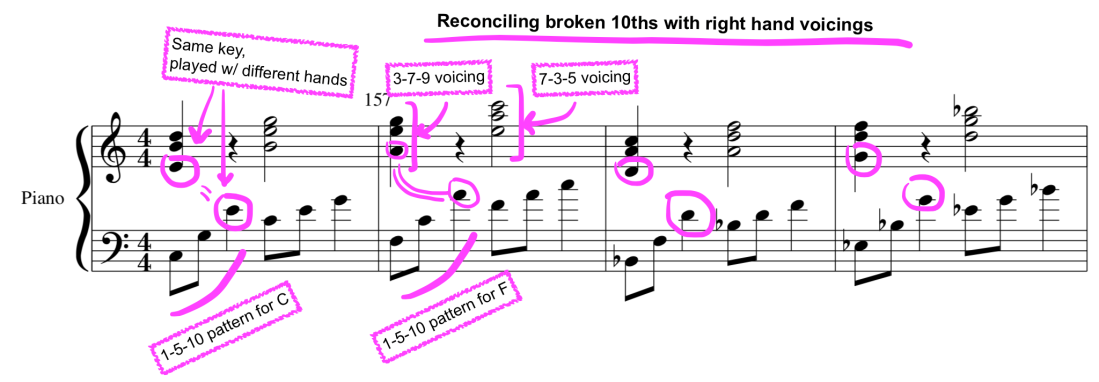
I love 10ths — broken 10ths literally opened the Pandora’s box of intervallic patterns for me. They’re a bit of a stretch at first (especially major, especially with accidentals), but once you’ve mastered them, your left hand accompaniment will never be the same. One annoying thing with broken 10ths, though, is that because of their span, there’s often an overlap with the right hand. Whenever my hands overlap, I get all panicky and screw everything up. In order to avoid this, I used to play right hand voicings 2 octaves above — just to be safe I have enough space to work on my 10ths. But, really, you have to face your fears, right? So here’s an exercise I’ve invented for this:

  • Play broken 10ths with the left hand
  • Play shell voicings (3-7-9) with the right
  • First note of the right hand voicing will be the 10th for the left hand
  • By the time you get to it with the left hand, move your right hand to 7-3-5 voicing of the same chord, octave above
  • No more fear of clashing-o-phobia! (Is that a word?)

Screenshot 2019-03-16 at 18.08.23.png

Piano day (1h 30m)

Scale studies

  • All Phrygian scales

Preparing pieces

Practicing a piece that I’m going to record later. (Should’ve also practiced my Logic score exporting skills so it won’t look that terrible 😬). Just an intro from the thing I’m working on. It’s an F# piece occasionally slipping to B major.

Screenshot 2019-03-18 at 21.19.18.png

Practicing arpeggios and extensions in modal context

I love combining different workouts in one so that I don’t spend two hours just doing arpeggios and then another two hours trying to make them work with right hand patterns. My approach is to work on both hands at the same time by putting emphasis on one of them and keeping the second busy with something super simple and minimally technical, yet still meaningful in terms of theory. But, there’s also a possibility to pack one more thing in an exercise — and that’s when you make it modal!

For this one a picked the classic Mixolydian progression: I7 — bVII∆7 and played it it using 7th chord arpeggios with left hand and doubled intervals in the right.

Stuff I improve while practicing this:

  • Modal DNA
  • Arpeggios
  • Diatonic intervals

Screenshot 2019-03-16 at 18.43.06.png


Sure enough, you can transpose it to any key or apply to any modal progression like Dorian i — IV7 or Phrygian i — bII∆7, etc.

On Hand Independence and Wasted Youth

I struggle with hand independence. It’s a fucking nightmare, I’m telling you. There’s a solution though: take Dohnányi exercises, play them for 10 years (starting when you were 4) — ? — PROFIT! My problem here: I started a bit later, and I hate exercises that sound like they were deliberately written to torture me and make me feel like crap. I love playing things that matter musically. So I thought, okay, why don’t I play some arpeggios with the left hand, like this:

Screenshot 2019-03-14 at 21.48.43

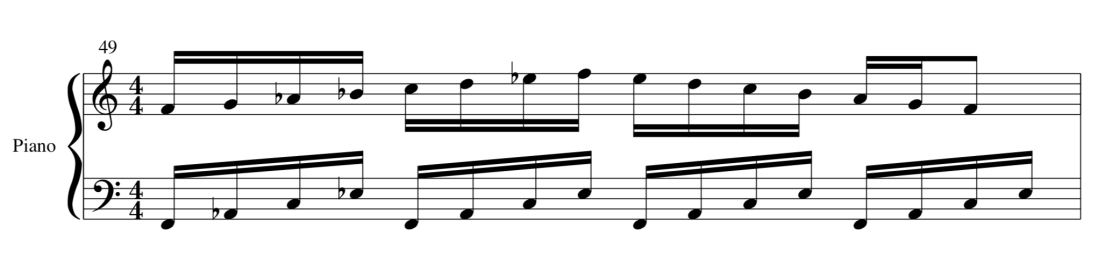
Then add some scale runs with right hand (F Dorian in this case), like so:
Screenshot 2019-03-14 at 21.50.07

Then stop playing the 5th in my left hand Fm7 arpeggio:

Screenshot 2019-03-14 at 21.53.07

Continue playing the same rhythmic figure with the left hand, but sex it up by switching to broken 10ths (F — C — Ab). Keep doing the scale thing with my right:

Screenshot 2019-03-14 at 21.54.53

Then go back to my Fm7 arp and instead of removing 5th, get rid of the 3rd, which will completely change the rhythmic pattern and fuck up the right hand. Switch to 10ths as soon as the right hand starts to unfuck itself again.

Screenshot 2019-03-14 at 22.00.25.png

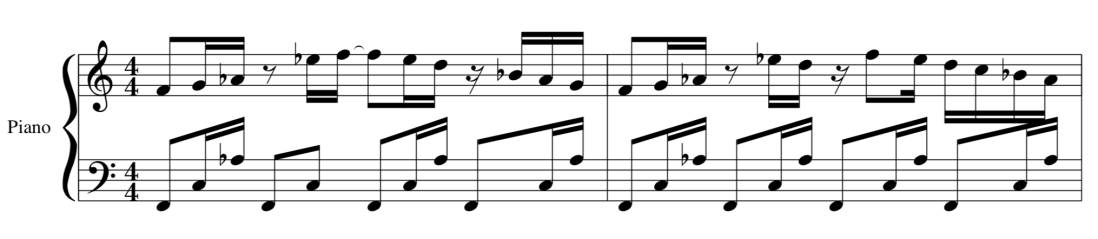
At every moment I can try and switch from running a scale to actually improvising in key to see if my left hand can handle it:
Screenshot 2019-03-14 at 22.03.13.png

Of course, there are also other things like other mode degrees to play with the left hand (for example, v or IV7 instead of i), other scales (like, parallel Lydian or Aeolian, you know?) etc. Thus, by the end of a 12-hour session, you will have achieved total hand independence and absolute fluency in all keys and all modes. All by doing just this one exercise!

Just kidding. Go build a time machine and start your piano lessons when you’re 4. Or at least build a time machine so people like me could practice more AND write about it! Laters—